Healthcare organisations often hold critical information in scanned PDFs, photographs and legacy documents. Medical OCR helps turn those images into machine-readable text, but clinical usefulness requires more than recognising characters: the system must preserve context, structure and uncertainty.
Medical OCR is a workflow, not a scan button
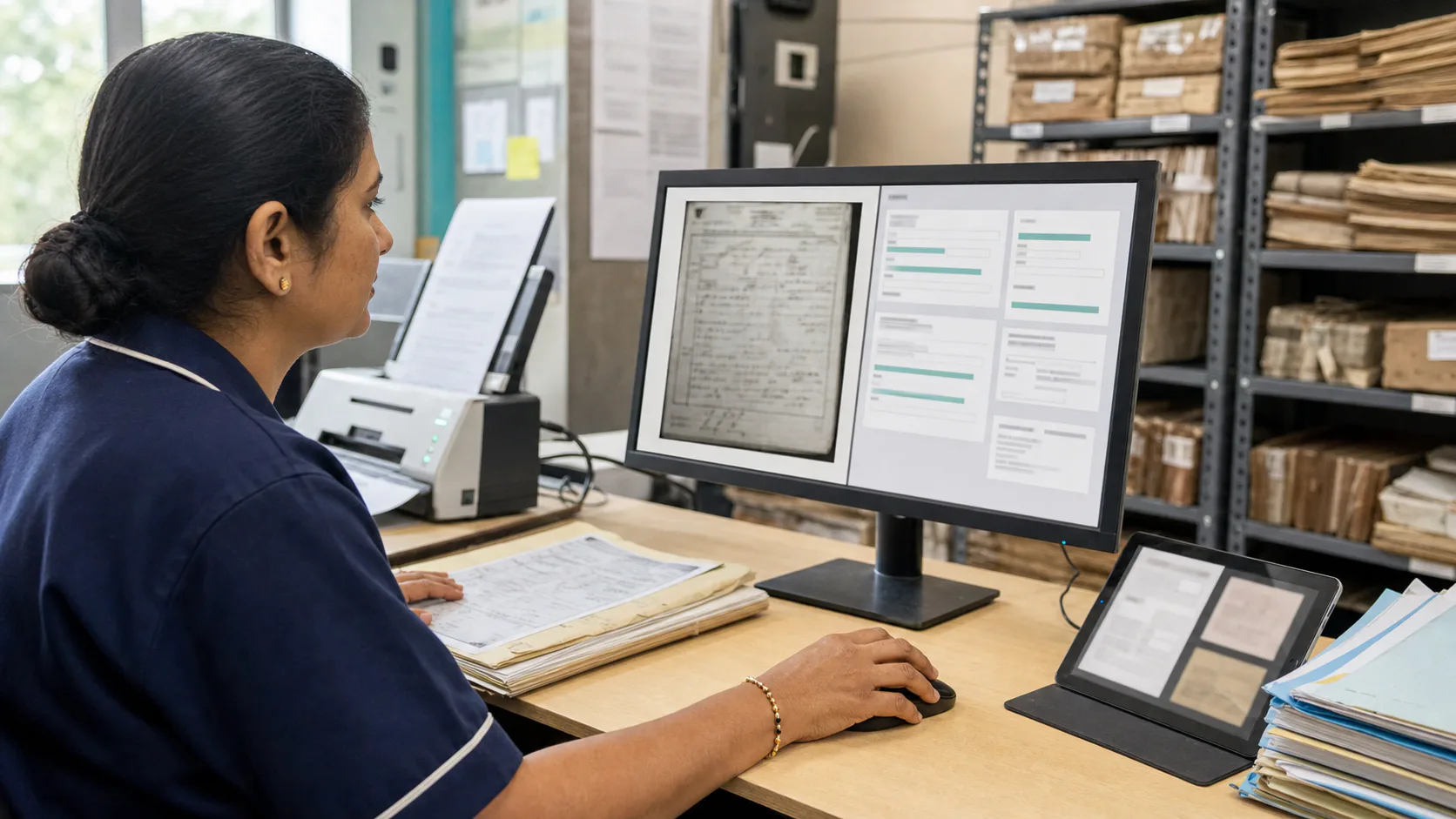
General OCR converts pixels into text. Medical OCR must also understand document layout, identify clinical entities and map information into a usable structure. A date beside a laboratory value, for example, has a different meaning from the same date beside a prescription.
The result should be a reviewable representation that points back to the source rather than replacing it with an opaque summary.
Documents that benefit from structured extraction
The strongest use cases are high-volume documents whose information is repeatedly searched, re-entered or compared across encounters.
- Prescriptions and medication lists
- Diagnostic and laboratory reports
- Discharge summaries and referral letters
- Prior records supplied by a patient
- Legacy forms and scanned clinical archives
What to evaluate beyond recognition accuracy
A single accuracy percentage hides the errors that matter most. Evaluate field-level performance for medicines, dosages, units, dates and negation. Review how the system behaves with handwriting, stamps, low-resolution photos and multi-page records.
- Source highlighting for every extracted field
- Confidence and exception handling
- Human review before downstream use
- Searchable, interoperable output rather than flat text
- Access controls appropriate to health information
From digitisation to a connected record
The value of OCR appears when structured information can support record review, care coordination and patient-controlled sharing. That requires a data model and integration layer after extraction.
Doxyte OCR sits within Doxyte’s healthcare data and context layer so reviewed information can move into connected workflows instead of becoming another isolated file repository.
Quick answers
Frequently asked questions
What is medical OCR?+
Medical OCR is the use of optical character recognition and document understanding to extract text and structured fields from clinical documents such as prescriptions, reports and discharge summaries.
Can OCR read handwritten prescriptions?+
Some systems can process handwriting, but performance varies by image quality and writing style. High-risk fields should be surfaced for human review.
How should extracted clinical data be validated?+
Reviewers should be able to compare each extracted field with the original source, see uncertainty and correct errors before information enters a clinical workflow.